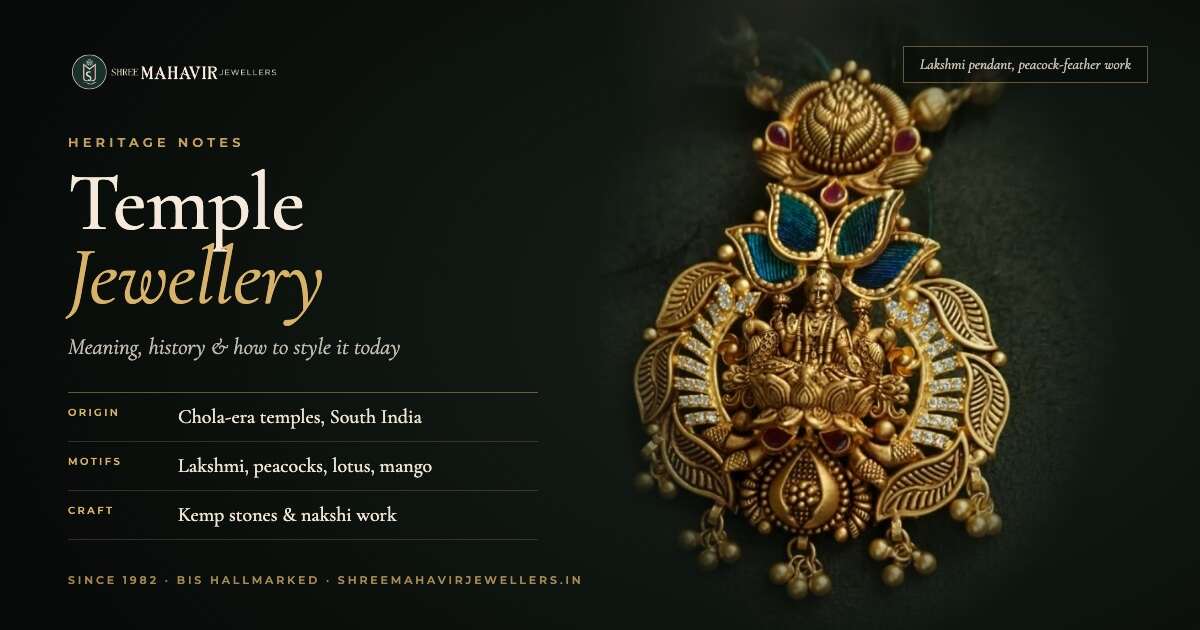
There’s a particular kind of gold jewellery that stops people in a showroom. Heavy, deliberately unmodern, built around carved figures of deities and stylised peacocks and mango shapes, often set with flat red and green stones that catch the light differently from faceted gems.
Someone almost always asks what it is, and when you say “temple jewellery,” the next question is usually whether it’s actually meant to be worn, or whether it belongs in a temple.
The answer is both, and the history of how it moved from one to the other is genuinely interesting. It’s also the most useful thing to understand before buying a piece, because temple jewellery is one of the few jewellery categories where knowing what a motif means changes how you wear it.
Where Temple Jewellery Actually Came From
The tradition began exactly where the name suggests. Across South India, the practice of adorning deity idols with elaborate gold ornaments is as old as temple worship itself, a tradition stretching back roughly two thousand years.
Temples commissioned the finest goldsmiths available to create ornaments for their presiding deities, and because these were offerings to the divine rather than commercial pieces, there was essentially no ceiling on craftsmanship or ambition.
The form we now recognise as temple jewellery crystallised largely under the Chola dynasty, around the ninth century onward, and continued developing through the Pallava and Vijayanagara periods.
These were empires that invested heavily in temple architecture and the arts, and the goldsmithing traditions that grew around their temples produced work of a quality that still sets the benchmark today.
The same artisanal vocabulary of motifs and techniques that went into temple architecture, the carved figures, the layered ornamentation, the symbolic density, went into the jewellery made for the deities inside.
From deity ornaments, the style travelled outward in two directions. It became the costume jewellery of classical dance, particularly Bharatanatyam, where temple jewellery remains part of the formal performance costume to this day.
And it became bridal adornment, worn by brides to carry the auspiciousness and divine association of the temple into a wedding ceremony.
That third move, from dance stage and wedding mandap into general jewellery wardrobes, is comparatively recent, and it’s why you can now walk into a jewellery shop in Mumbai and buy a temple-style pendant set without any South Indian connection at all.
The Motifs, and What They Mean
Temple jewellery is unusual in that nearly every element carries specific meaning. This isn’t decorative abstraction; the figures are identifiable deities and the shapes are drawn from a symbolic vocabulary that was never arbitrary.
The most common central figure is Lakshmi, the goddess of prosperity and wealth, which is why Lakshmi motif pieces are so closely associated with weddings and new beginnings. Gajalakshmi, Lakshmi flanked by elephants, is another recurring form.
The peacock appears constantly, associated with grace, beauty, and in some traditions with specific deities. Mango shapes, the paisley-like form that gives the mango mala its name, carry associations with fertility and abundance.
None of this is obscure symbolism known only to specialists; it’s the reason the pieces were made in those shapes in the first place, and it’s a legitimate factor in choosing a piece. A bride choosing a Lakshmi haram for her wedding is making a meaningful choice, not just an aesthetic one.
Learning the Vocabulary: The Main Pieces
Temple jewellery comes with its own set of names, which can be bewildering at first. The ones worth knowing:
- Lakshmi haram is a long necklace built around Lakshmi motifs, typically the centrepiece of a bridal temple set.
- Kasu mala (also called kasulaperu) is a coin necklace, built from rows of small gold discs often stamped with deity figures. The coin form itself traces back to a time when gold coins were literally strung as wearable wealth.
- Mango mala uses repeated mango-shaped elements along the length of the necklace.
- Vanki is the armlet, a distinctive V or inverted-V shaped band worn on the upper arm, one of the most recognisably South Indian pieces in the entire tradition.
- Oddiyanam is the waist belt, worn over a saree, typically the single heaviest and most elaborate piece in a full bridal temple set.
- Temple jhumkas (also jimikki) are the bell-shaped hanging earrings, probably the single most widely adopted temple piece outside South India, because they work with almost anything.
- Guttapusalu is a pearl-heavy style where clusters of small pearls hang in strands below a gold framework, visually quite distinct from stone-set temple work.
Kemp Stones, Nakshi Work, and Why Not All Temple Jewellery Looks Alike
One genuine misconception worth clearing up: people often use “kemp jewellery” and “temple jewellery” interchangeably, but kemp is one style within temple jewellery, not the whole category.
Kemp refers specifically to the flat, uncut red and green stones that give many temple pieces their characteristic look. They aren’t faceted like modern gemstones, which is exactly why they read as traditional rather than contemporary.
Plenty of temple jewellery uses no kemp stones at all. Nakshi work is stone-free, relying entirely on hand-carved and repoussé gold detailing, figures and patterns worked into the metal itself. Guttapusalu leans on pearls.
Kerala’s palakka style has its own distinct green-stone vocabulary.
So if you’ve decided temple jewellery isn’t for you because you don’t like the red-and-green stone look, it’s worth knowing that’s one branch of a much wider tradition, and stone-free nakshi pieces are often the more versatile choice for anyone wanting temple craftsmanship in a more restrained form.
Styling It Without Looking Like You’re in Costume
Here’s where most practical advice goes wrong: it assumes temple jewellery is either full bridal or nothing. In practice there’s a wide middle ground, and the governing rule is simply that temple jewellery is visually dense, so it wants either a simple canvas or deliberate restraint elsewhere.
With silk sarees, especially Kanjeevaram, temple jewellery is the natural pairing; the weight and formality of the fabric match the weight of the jewellery.
Deep saturated colours, maroon, emerald green, royal blue, set off the gold tones better than pale shades do, which is why you see those combinations so often at South Indian weddings.
For a full traditional look, a broad temple necklace with matched earrings is the anchor, and anything else you add should be quieter.
For everything else, the useful move is to pick exactly one temple piece and let it do all the work. A single pair of temple jhumkas with a plain cotton or linen saree, a kurta, or even a solid-colour western outfit reads as considered rather than costumed.
A temple-style pendant on a plain chain works the same way. This is how a lot of our customers in Ghatkopar actually wear temple pieces day to day: one strong element, nothing competing with it.
If you want to go further, a temple-motif pendant set paired with plain gold bangles keeps the look grounded without flattening it.
The failure mode to avoid is wearing several heavy temple pieces at once outside a wedding context. The tradition was built for occasions where maximum ornamentation was the point, and borrowed into everyday wear, it needs editing.
Buying Temple Jewellery: What to Actually Check
A few things matter more here than with plainer gold work. First, examine the carving quality closely. Temple jewellery lives entirely on its detail, and the difference between crisp, deeply worked figures and soft, flattened ones is visible within seconds once you know to look. Hold two pieces side by side and the gap becomes obvious.
Second, check how stones are set. Kemp stones in a well-made piece sit firmly in properly formed bezels; in a poorly made one they sit loose or unevenly, and they’re the first thing to fall out over years of wear.
Third, be clear about weight and wearability before you fall for a design. Temple pieces are typically heavier than contemporary equivalents because the ornamentation is the point, and a full haram or oddiyanam is genuinely substantial. For a wedding that’s fine. For something you want to wear more often, go lighter than your first instinct.
Fourth, purity and certification. Any gold temple piece should carry a valid BIS hallmark with its HUID code, and since these pieces often represent a significant amount of gold, the certification matters in real rupee terms.
22 karat gold gives the warm, traditional tone that suits temple work best, while 18 karat is harder and holds intricate detail and stone settings more securely over time, which is a genuine consideration for heavily worked pieces.
Why It Has Lasted
What strikes us, after three generations of selling gold in this neighbourhood, is how little temple jewellery has needed to change to stay relevant. Fashion jewellery turns over every few years.
Temple designs have survived roughly twelve centuries largely intact, because they were never designed to be fashionable in the first place; they were designed to be worthy of a deity, and that’s a brief that doesn’t expire.
We keep temple-style work across several categories at our Ghatkopar West showroom, including necklace sets, pendant sets, and earrings including traditional jhumka forms, all BIS hallmarked with verifiable HUID codes.
If you’re deciding between a full traditional set and a single versatile piece, that’s genuinely easier to work out in person with the pieces in front of you. We’re open Friday through Wednesday, 11am to 8:30pm, on L.B.S. Marg.