Every bride who walks into our Ghatkopar West showroom with a wedding date in hand eventually asks some version of the same question: how much jewellery do I actually need?
It’s a fair question, and an oddly hard one to get a straight answer to, because most of what’s written on the subject either lists every ornament ever worn by any Indian bride anywhere, which is overwhelming and impractical, or oversimplifies to “just get a necklace set,” which underestimates how many separate functions a modern wedding actually has.
The honest answer is that it depends heavily on how many functions you’re dressing for, your family’s traditions, and your budget, but there’s a sensible way to think it through rather than buying reactively as each function approaches. This is the checklist we actually walk brides through at the counter.
Start With Your Functions, Not Your Wishlist
The single biggest planning mistake is approaching bridal jewellery as one big shopping list instead of mapping it against your actual wedding calendar.
A contemporary Indian wedding typically spans several distinct functions, haldi, mehendi, sangeet, the wedding ceremony itself, and the reception, and each one has a different dress code, a different colour palette, and a different practical need from jewellery.
Jewellery that’s perfect for a haldi, worn in bright yellow with turmeric paste flying around, is not jewellery you want to be precious about. Jewellery for the wedding ceremony itself is usually the heaviest, most traditional, most photographed piece of the lot.
Reception jewellery, increasingly, leans more contemporary and photo-friendly, often lighter than the wedding day look.
Once you lay out your actual function list, the jewellery question becomes much more concrete: what do you need for each specific day, rather than what exists in the category generally.
The Core List: What Most Brides Actually End Up Wearing
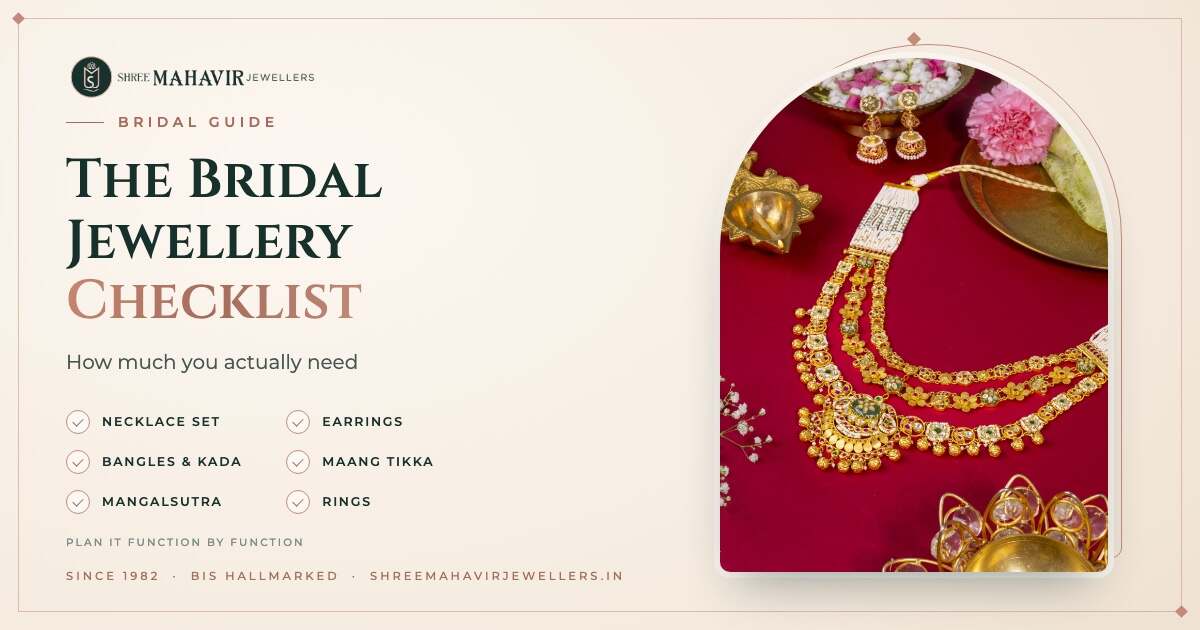
Strip away the regional variation and the core bridal checklist most brides work from looks roughly like this:
- A bridal necklace or necklace set, the centrepiece of the wedding-day look, usually the single most expensive piece and the one most worth getting right rather than rushing.
- The mangalsutra, which functions differently from everything else on this list: it’s not primarily a styling choice, it’s the piece you’ll actually wear every single day afterward, so it deserves its own decision process separate from the rest of the wedding look.
- Earrings, ideally chosen to work for more than one occasion. Long jhumka-style earrings suit the ceremony itself, while a lighter diamond or gold pair often works better for the reception and for everyday wear afterward.
- Bangles or a kada, usually the most visually prominent element after the necklace, especially in photos where hands are constantly in frame.
- Rings, typically at minimum an engagement ring and a wedding band, sometimes with separate rings for different functions.
- A maang tikka, the forehead ornament, standard for most North Indian bridal looks and optional in several South Indian traditions.
- Nath (nose ring) and hathphool (hand harness connecting rings to a wrist bracelet), both regionally significant pieces that some brides treat as essential and others skip entirely depending on their community’s tradition.
- A kamarband or waist belt, more common in South Indian and some North Indian bridal looks, usually reserved for the heaviest, most formal function.
Not every bride wears every item on this list, and that’s exactly the point: the list is a menu to select from based on your traditions and functions, not a mandatory checklist where skipping something is a mistake.
What Genuinely Needs to Be New, and What Doesn’t
This is where families can save real money and real stress without compromising on the day itself.
Family heirloom pieces, a grandmother’s necklace, an aunt’s bangles, often anchor a bridal look beautifully and carry far more meaning than anything bought fresh, as long as they’re in good condition and sized correctly.
It’s worth getting any inherited piece checked and, if needed, lightly serviced or resized well before the wedding rather than discovering a clasp issue the morning of.
For pieces that need to be new, prioritise by how long they’ll matter after the wedding. The mangalsutra and wedding rings get worn for decades, so they deserve the most deliberation on comfort, purity, and construction, not just appearance on the day.
Occasion-specific heavy pieces, a kamarband, a particularly elaborate ceremony necklace, matter enormously for one day and then largely live in a locker, which is a completely reasonable thing to buy for the day it’s meant for, but worth being clear-eyed about before overspending there at the expense of pieces you’ll actually use for years.
Rent, Buy, or Both
For the heaviest, most elaborate occasion-only pieces, renting has become a genuinely sensible option for many brides, particularly for a single-use kamarband or an extremely heavy ceremonial necklace that won’t realistically get worn again.
Buying makes more sense for anything with long-term wear ahead of it: the mangalsutra, rings, versatile earrings, and any piece a bride expects to style into her everyday or festive wardrobe for years.
A practical approach many of our customers land on is a hybrid: buy the pieces that will have a life after the wedding, and rent or borrow the single-occasion showstoppers that exist mainly for one set of photographs.
Budgeting Function by Function
Rather than setting one lump bridal jewellery budget, it helps to allocate roughly by function and by person, since a wedding budget covers more than just the bride.
Decide early what you’re spending on the bride’s core pieces (necklace, mangalsutra, earrings, bangles), what’s being allocated to lighter function-specific pieces (haldi and mehendi jewellery, which should be inexpensive and durable rather than precious), and what, if anything, is being set aside for family members in the wedding party.
Setting these buckets early, well before you start shopping, prevents the common problem of overspending on the first piece bought and then scrambling on everything after.
Earrings Deserve More Thought Than They Usually Get
Of everything on the bridal list, earrings are the piece most worth choosing for life after the wedding rather than just for the day. A long traditional jhumka pair looks spectacular in ceremony photographs but may not get much wear afterward if it doesn’t suit your daily style.
Many brides now deliberately choose one dramatic pair for the ceremony and a second, more versatile gold or diamond pair for the reception, one that transitions easily into formal events and everyday festive wear for years afterward. If budget is tight, the versatile pair is usually the better long-term buy of the two.
Timing: Start Earlier Than Feels Necessary
The single most common regret we hear from brides is leaving jewellery decisions until too close to the wedding date.
Anything involving custom sizing, a particular design request, or coordinating heirloom pieces with new purchases takes real time to get right, and rushing it is exactly how avoidable problems happen: a necklace that sits wrong in photos, a bangle bought in a hurry that doesn’t actually fit, a mangalsutra clasp that wasn’t properly tested before the big day.
Starting the jewellery conversation months rather than weeks before the wedding gives you room to actually try pieces on, compare options without pressure, and get any resizing or hallmark verification done calmly.
A Simple Way to Decide
If you take nothing else from this, take the ordering principle: map your actual functions first, decide what’s being inherited versus bought new, separate the pieces with a life after the wedding from the pieces that exist for one day only, and start the process early.
Everything else, how many bangles, whether you want a nath, which earrings for which function, becomes much easier to decide once that structure is in place.
We help brides work through exactly this at our Ghatkopar West showroom, from a full bridal necklace set to the mangalsutra that comes after it, along with bangles and earrings chosen to work for more than one function. All BIS hallmarked, all with verifiable HUID codes.
Come in with your function list and your dates and we’ll help you build the checklist properly rather than piece by piece under pressure. We’re open Friday through Wednesday, 11am to 8:30pm, on L.B.S. Marg.