If you’ve bought gold jewellery in India any time in the last few years, you’ve probably noticed a tiny cluster of marks stamped somewhere discreet, inside a bangle, on the clasp of a chain, at the back of a ring. Most people glance past it. Few actually know how to read it, or why it matters far more than the shine of the piece itself.
That small stamp is your only real proof of what you’re paying for. Here’s how to actually read it.
The Three Things a Genuine BIS Hallmark Always Has
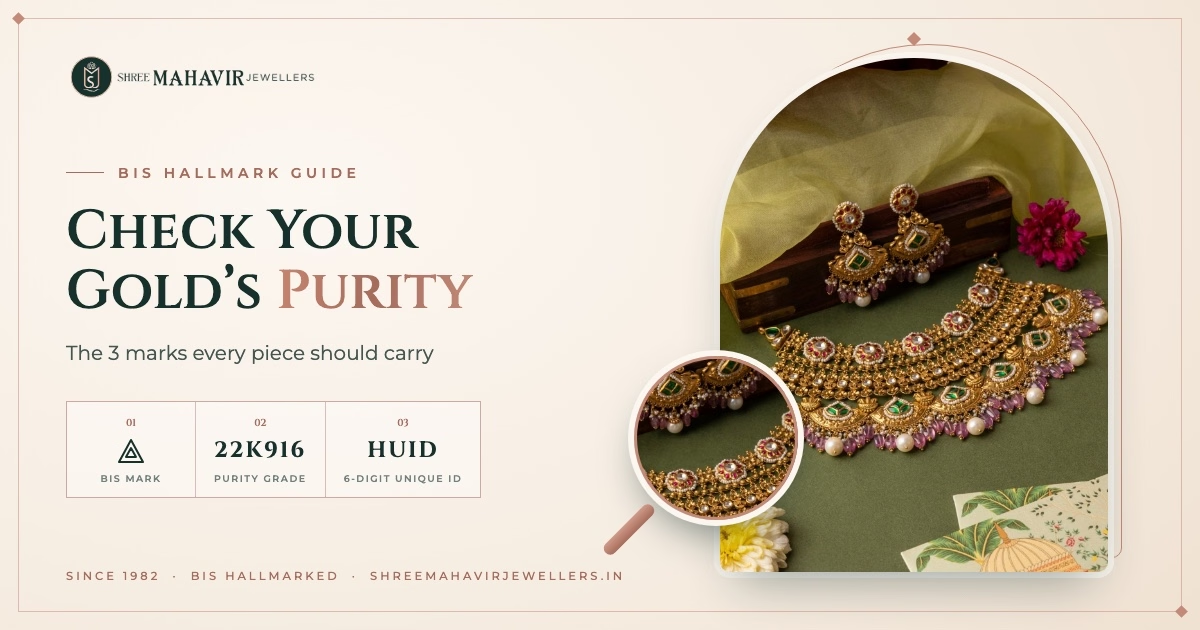
A valid hallmark on gold jewellery sold in India isn’t a single symbol; it’s a set of three marks that must appear together:
- The BIS triangle logo, the mark of the Bureau of Indian Standards itself, confirming the piece was certified through an authorised Assaying and Hallmarking Centre.
- The purity/fineness number, a three-digit code stamped directly on the metal (not printed on a tag) telling you exactly how pure the gold is.
- The HUID, a six-character alphanumeric code, unique to that individual piece, that links it back to the exact hallmarking centre and jeweller who certified it.
If any one of these three is missing, what you’re looking at isn’t a complete, verifiable hallmark, regardless of how convincing the stamp looks.
Decoding the Purity Number
The three-digit number is the part most people misread or ignore entirely, and it’s the single most useful number on the entire piece. It tells you the parts-per-thousand purity of the gold:
- 999: 24 karat, the purest form of gold. Too soft on its own for jewellery that needs to hold its shape through daily wear, which is why you’ll mostly see it in coins and bars rather than rings or bangles.
- 916: 22 karat, roughly 91.6% pure gold. This is the standard for most traditional Indian jewellery, bangles, mangalsutras, temple sets, because it strikes the balance between richness of colour and enough durability to actually be worn.
- 750: 18 karat, 75% pure gold. More common in diamond-studded or gem-set pieces, where the extra alloy adds strength to hold stones securely and often gives a slightly different, more contemporary tone.
- 585: 14 karat, 58.5% pure gold. Less common in Indian traditional jewellery but occasionally used in Western-style or heavily worked pieces where maximum durability matters more than gold content.
None of these purities is “better” in an absolute sense, they’re suited to different kinds of pieces. A heavy antique kada benefits from the richness of 916, while a delicate diamond pendant set might genuinely perform better at 750. What matters isn’t which one you choose, but that the number stamped on your piece matches what you were told at the counter.
What the HUID Actually Does For You
The HUID is the newer, and arguably more powerful, part of the hallmark. Before it became mandatory, hallmarking could confirm purity in a general sense, but it was harder to trace a specific piece back to a specific hallmarking event. The HUID closes that gap, it’s a unique six-character code assigned to that one piece and no other, generated at the moment it was certified.
You can verify any HUID yourself, for free, in under a minute:
- Download the official BIS CARE app (available for Android and iOS).
- Open the “Verify HUID” section.
- Enter the six-character code exactly as stamped on your piece.
- The app shows you the purity, the registered hallmarking centre, and the jeweller it was certified for.
This takes the guesswork completely out of the equation. You’re not trusting a jeweller’s word or a receipt; you’re checking against a government-maintained record that exists independently of the shop you bought it from.
Why This Matters More at the Time of Resale or Exchange
Most people think about hallmarking only at the time of purchase, but it matters just as much, arguably more, when you go to exchange old jewellery or sell it back. A verifiable HUID and an accurate purity stamp mean there’s no ambiguity or negotiation needed over what the piece is actually worth. Unmarked or vaguely-marked gold almost always gets valued conservatively, because the buyer has no way to confirm purity except by testing it themselves, which takes time and sometimes costs you in the process.
This is one of the quieter reasons hallmarking protects you as a buyer long after the purchase is done: it preserves the resale and exchange value of what you already own.
What To Actually Check Before You Buy
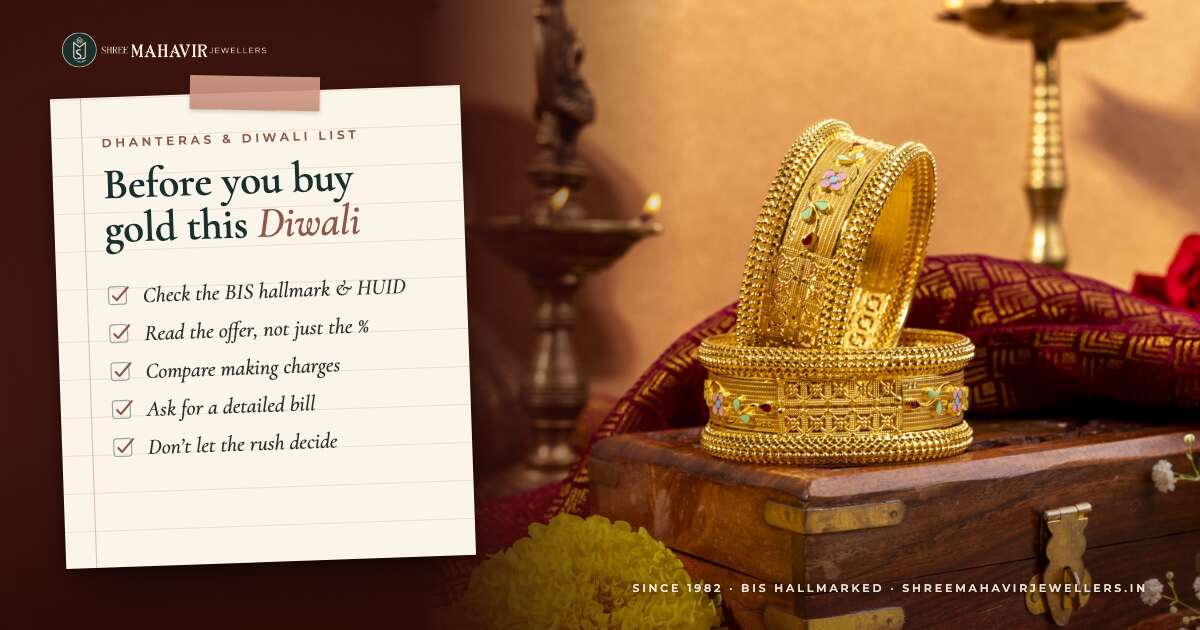
Next time you’re at a jewellery counter, whether it’s ours or anyone else’s, here’s the practical checklist worth running through:
- Look for the hallmark stamped directly on the metal, not just printed on an attached tag, which can be swapped.
- Confirm all three marks are present: the BIS triangle, the purity number, and the HUID.
- Ask the jeweller to show you where the purity number is stamped, and check it matches what’s on your bill.
- If you want extra confidence, verify the HUID on the BIS CARE app before you leave the store, any legitimate jeweller will have no issue with this.
At Shree Mahavir Jewellers, every piece across our women’s collection, from mangalsutras and bangles to necklace sets, and our men’s line of kadas, pendants, and rings, carries a complete BIS hallmark with HUID. It’s not an add-on service or a premium option; it’s simply how we’ve done business for three generations, long before hallmarking was even a legal requirement.
If you’re ever unsure about a piece you already own, bring it in, we’re happy to walk you through reading its hallmark in person, no purchase necessary. Purity shouldn’t be a mystery, and a jeweller who’s confident in their gold will never make you feel like it is.