Diwali is, without much competition, the busiest stretch of the year for any gold jeweller in India. Dhanteras alone brings more footfall through our Ghatkopar West showroom than almost any other single day, and the fortnight around it is when a large share of households make their one significant gold purchase of the year. That concentration of demand is exactly why it’s worth shopping a little more carefully during Diwali than you might the rest of the year, not because the risk is unusually high everywhere, but because the volume of transactions, the festive discount noise, and the sheer rush all make it easier to skip a step you’d normally take your time over.
This is the guide we actually give customers who come in during the Diwali season, covering why the day matters, what genuinely changes about buying gold during this period, and what to check before you commit to anything.
Why Dhanteras and Diwali Are Tied to Gold
Dhanteras, also called Dhan Trayodashi, falls on the thirteenth lunar day and marks the start of the five days of Diwali. The day carries a layered significance: it’s associated with the worship of Lord Dhanvantari, considered the god of health and the originator of Ayurveda, and separately with inviting Goddess Lakshmi, the goddess of wealth, into the home for the year ahead. Buying gold or silver on this day is understood as both a welcome to Lakshmi and an act of securing prosperity for the household, which is precisely why it has remained, across generations and regions, the single most popular day in the entire year to buy precious metal.
Because Dhanteras opens the Diwali period rather than standing alone, a lot of households spread their festive gold buying across the surrounding days rather than compressing everything into the one date, picking up a piece before or after Dhanteras itself depending on when they can shop without rushing. That flexibility is worth remembering if you’re dreading a single crowded day; the sentiment of the season matters more than hitting one exact date.
What Actually Changes During the Festive Rush
A few things shift specifically during this period that are worth knowing before you walk in. First, footfall is dramatically higher than normal, which means longer waits, busier staff, and less unhurried browsing time than you’d get on an ordinary weekday. Second, gold demand itself tends to spike seasonally around Navratri and Dhanteras, which can put upward pressure on prices right when the most people are buying, so the sense that you’re paying a premium simply for buying during the rush isn’t entirely imagined. Third, this is also the season when festive schemes, discounts, and promotional offers are most aggressively marketed, and while plenty of these are genuine, it’s exactly the environment where it’s worth reading the fine print rather than getting swept up in the energy of the season.
Reading Festive Offers Properly
Discount schemes during Diwali generally take one of a few forms: a flat discount on making charges, a “buy gold, get a gift” bundling offer, or an advance-payment savings scheme where you pay in instalments ahead of the festival and redeem the accumulated value at Diwali. None of these are inherently problematic, but each is worth evaluating on its actual terms rather than its headline. A making-charges discount is only meaningful if the base making-charge rate wasn’t inflated to begin with, so it’s fair to ask what the standard, non-discounted making charge would be before judging how good the offer really is. A “free gift” bundled with a purchase is worth mentally pricing at zero when comparing value, rather than letting it tip the decision on a piece you weren’t otherwise sure about. And with any instalment-based gold savings scheme, read exactly what you get at redemption, whether it’s locked to a specific purity, whether the final value is fixed or market-linked, and what happens if you need to exit early, before committing to a multi-month plan.
The Checks That Matter More During a Rush
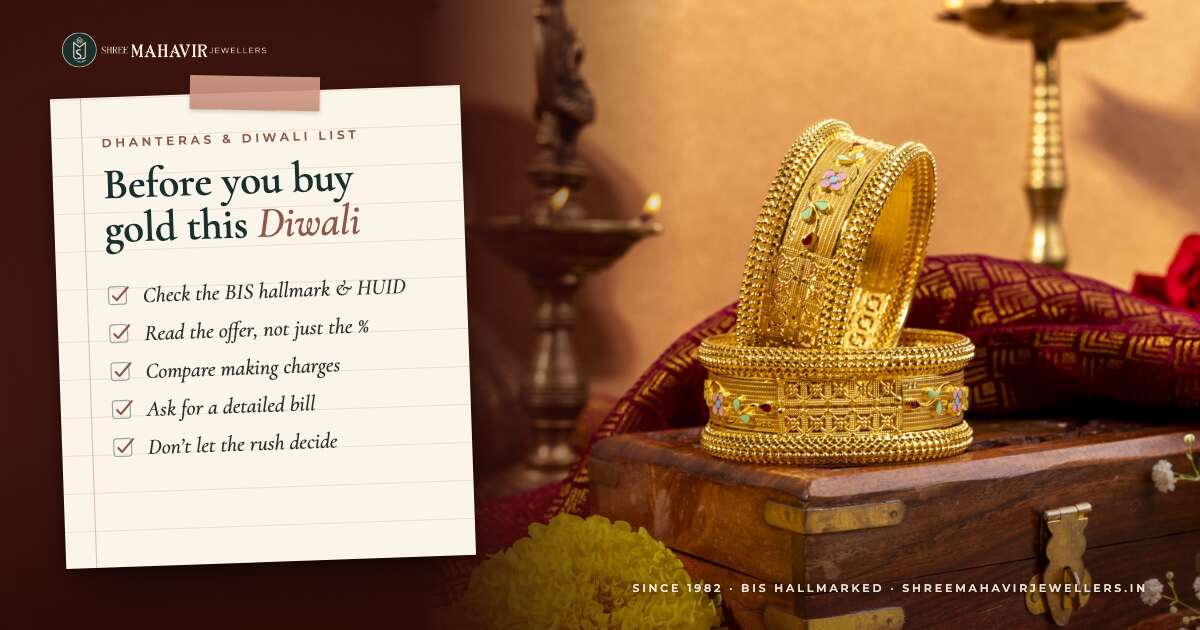
Everything that matters on an ordinary gold purchase matters just as much, if not more, during the Diwali crush, precisely because it’s the moment you’re most likely to feel rushed into skipping a step.
Insist on seeing the BIS hallmark on any piece before you commit, the small triangular mark along with the purity grade (916 for 22 karat, 750 for 18 karat) and the six-character HUID code unique to that piece. A busy showroom floor is not a reason to skip checking it; any legitimate jeweller expects customers to look, festive season or not. If you want extra certainty, the BIS CARE app lets you verify a HUID in under a minute.
Get an itemised bill that separates the gold value, the making charges, and GST (3% on the gold value, 5% on making charges), rather than accepting a single rounded total. This matters for comparing prices across shops and for any future resale, exchange, or insurance claim.
Pay digitally rather than in cash wherever possible. Beyond the general advisability of keeping a clean transaction trail, a digital payment record is simply easier to produce later if there’s ever a dispute about what you paid or when.
And resist the specific pressure of festive urgency itself. A piece that seems perfect in a crowded, noisy showroom on Dhanteras evening sometimes looks different a week later in a calmer moment, and there’s no rule that says the purchase has to happen on the single most auspicious day rather than sometime during the broader festive window.
Jewellery, Coins, or a Savings Scheme
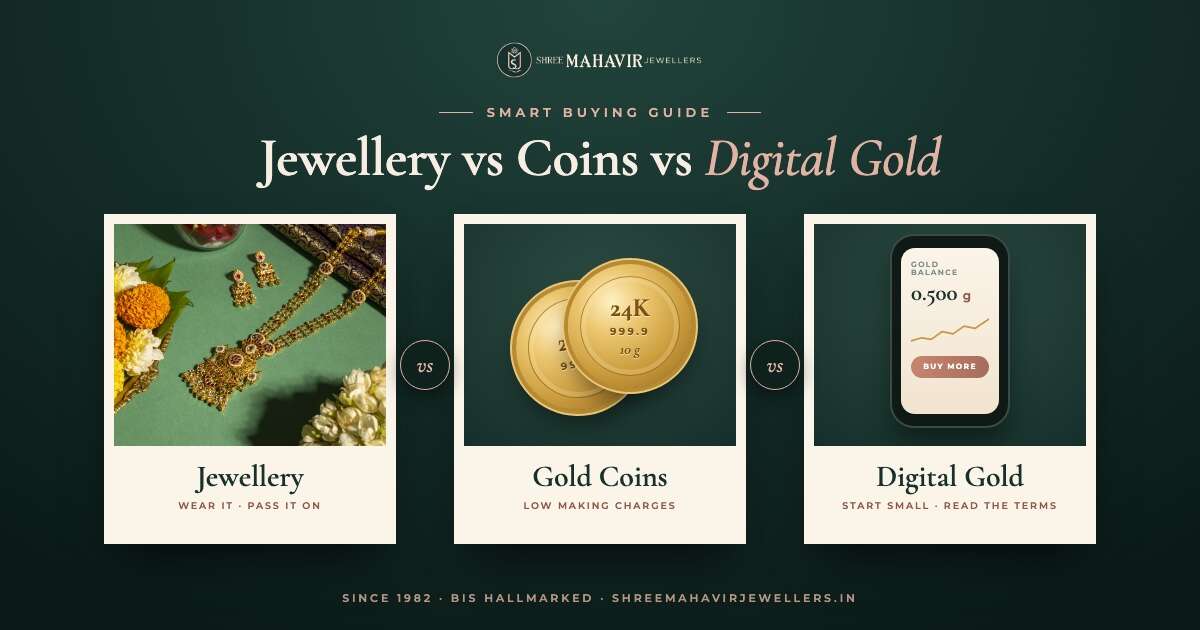
The same three broad choices that apply to any gold purchase apply here, with one Diwali-specific wrinkle worth mentioning. Jewellery makes sense if you want something to wear and are buying with occasion or gifting in mind. Coins are the cleaner, lower-premium choice if the point is simply to observe the Dhanteras tradition of bringing gold into the house, without needing it to be wearable.
The wrinkle is that Diwali, more than any other time of year, is when gold savings schemes get marketed hardest, and they’re worth a genuine look if the goal is spreading a planned Diwali purchase across the months beforehand rather than paying the full amount in one go during the peak-demand window. We run our own such scheme, Lucky Lakshmi, specifically because a lot of our regular customers prefer paying in smaller monthly amounts across the year and redeeming the value at Diwali rather than feeling the full price in one lump sum during the festive rush. It’s worth asking any jeweller you trust whether they offer something similar if that pacing appeals to you.
Don’t Let the Season Rush the Decision
The single most useful piece of advice we can give is the least exciting one: treat Dhanteras and Diwali as the occasion to complete a gold purchase you’ve already thought through, rather than the trigger to make a rushed one. Visit before the absolute peak days if you can, compare offers on their real terms rather than their headlines, and don’t let a queue behind you shorten the five minutes it takes to check a hallmark properly. The tradition has survived for generations precisely because it’s about bringing a durable, auspicious asset into the home, and that’s worth getting right rather than getting fast.
We’re open through the full Diwali period at our Ghatkopar West showroom, with a full range of necklace sets, bangles, and men’s rings alongside gold coins for the Dhanteras tradition itself, all BIS hallmarked with verifiable HUID codes. Come in before the rush if you can, and we’ll help you choose calmly rather than quickly. We’re open Friday through Wednesday, 11am to 8:30pm, on L.B.S. Marg.