Ask most people what they paid for their gold jewellery, and they’ll tell you the weight and the “rate” that day. Ask them what portion of that bill was making charges, and most go quiet. It’s the single most misunderstood line item on a gold jewellery bill, and also the one place where two jewellers selling the same design can genuinely differ.
Here’s what making charges actually are, how they’re calculated, and what’s worth asking about before you pay.
What Making Charges Actually Cover
The gold rate on any given day covers the raw material, the metal itself, priced by weight and purity. Making charges are separate: they cover the labour, craftsmanship, and skill that goes into turning that raw gold into an actual, wearable piece of jewellery. A plain gold band and an intricately worked antique kada might use similar weights of gold, but the kada demands far more skilled handwork, and that difference shows up entirely in the making charges, not the gold price.
In practice, making charges in India typically fall somewhere between roughly 6% and 25% of the gold value, though this range moves depending on three main factors:
- Design complexity, intricate filigree, kundan work, or hand-carved detailing takes longer and demands more skill than a simple polished band, and the making charge reflects that.
- Craftsmanship type, handmade traditional pieces generally carry higher making charges than machine-made designs, simply because of the labour hours involved.
- The jeweller, making charges aren’t fixed by any regulator; each jeweller sets their own, which is exactly why the same design can be priced differently at two different shops even on the same day, at the same gold rate.
Two Ways Jewellers Calculate It
There isn’t one universal method, most jewellers use one of two approaches:
- Percentage of gold value, making charges are calculated as a percentage of the day’s gold rate multiplied by the weight of your piece. A heavier piece naturally carries a higher making charge in absolute terms, even at the same percentage.
- Flat rate per gram, a fixed making charge is applied per gram of gold, regardless of the day’s gold rate. This method tends to be more predictable and transparent, since it doesn’t move with daily gold price fluctuations.
Neither method is inherently better, but it’s worth knowing which one your jeweller uses, because it changes how the final number is arrived at, and makes it much easier to compare quotes between two pieces or two shops.
Where “Wastage” Charges Fit In
Some jewellers list a separate “wastage” charge alongside making charges. Historically, this covered the small amount of gold genuinely lost during the crafting process, filing, polishing, and shaping inevitably shave off tiny amounts of metal. In many modern billing practices, wastage and making charges are combined into a single making-charge percentage rather than itemised separately, but it’s still worth asking your jeweller directly whether your bill separates the two or bundles them, so you know exactly what you’re being charged for.
Don’t Forget GST, It Applies to Both, Differently
This is the part that catches a lot of buyers off guard: GST doesn’t apply as one flat percentage across your entire bill. It’s applied separately:
- 3% GST on the value of the gold itself
- 5% GST on the making charges specifically
So the full calculation looks roughly like this:
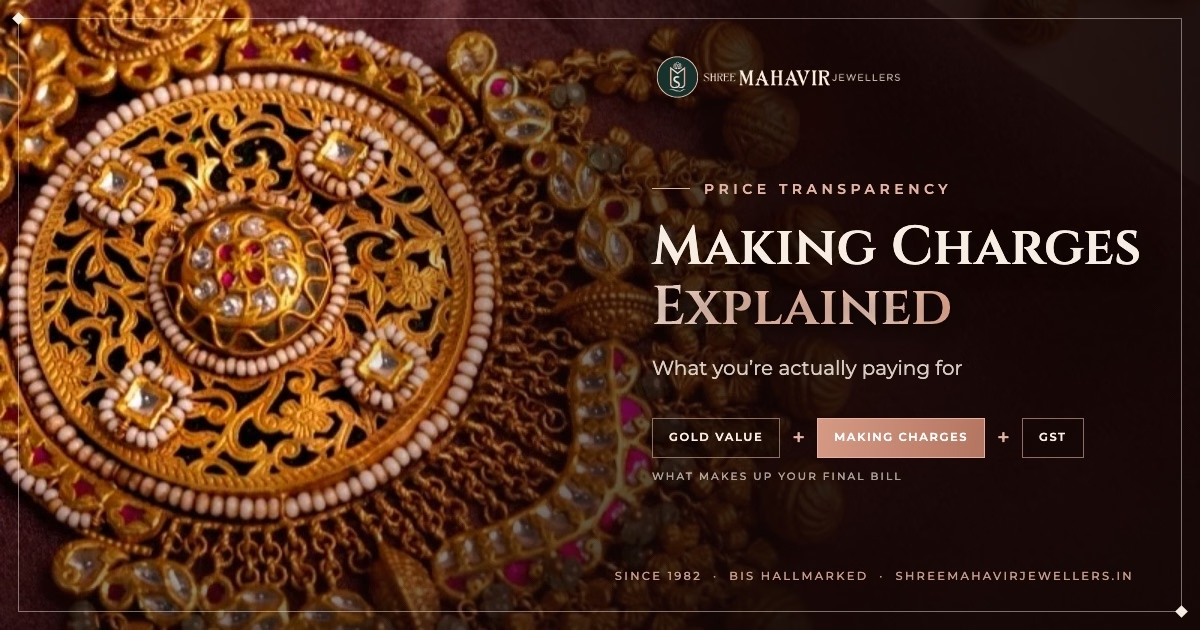
(Gold rate × weight) + Making charges + 3% GST on the gold value + 5% GST on the making charges = Final bill
If your jeweller’s bill doesn’t clearly break this out, ask them to walk you through each line, a transparent jeweller will have no trouble doing this on the spot.
Can You Negotiate Making Charges?
To some extent, yes, particularly on simpler, higher-volume designs where the jeweller has more margin flexibility. Heavily detailed, custom, or intricate antique pieces tend to have far less room to move, simply because the labour cost behind them is real and largely fixed. A good rule of thumb: it’s more reasonable to ask about making charges on plain bangles, chains, or simple rings than on elaborately worked temple jewellery or bridal sets, where the craftsmanship itself is a significant part of what you’re paying for.
What We Do Differently
At Shree Mahavir Jewellers, making charges are quoted upfront and explained clearly before you commit to a purchase, not buried in a final total. Whether you’re looking at a simple pair of bangles, a detailed bridal necklace set, or a men’s kada, you’ll know exactly what portion of your bill is gold, what’s craftsmanship, and what’s tax, before you decide.
If you’re planning a purchase and want a clear estimate ahead of time, our Lucky Lakshmi Gold Savings Plan is also worth a look, it lets you plan for both the gold value and the making charges gradually, rather than absorbing the full cost in one visit.
Understanding making charges doesn’t just help you compare prices, it helps you understand exactly what you’re paying a skilled craftsperson for, which, for jewellery meant to last generations, is worth knowing.