Almost every customer who comes in asking about gold eventually asks some version of the same follow-up question: should I actually buy jewellery, or would a coin, or even digital gold, make more sense? It’s a genuinely good question, and the honest answer is that it depends entirely on what you’re trying to do with the gold. Buying to wear is a different decision from buying to hold value, and the three common forms, jewellery, coins, and digital gold, are built for different purposes even though they’re all, in the end, gold.
We sell mostly jewellery at our Ghatkopar West showroom, but we’d rather give you an honest comparison than pretend jewellery is the right answer for every situation, because it genuinely isn’t.
The Core Trade-Off: Wearable Versus Efficient
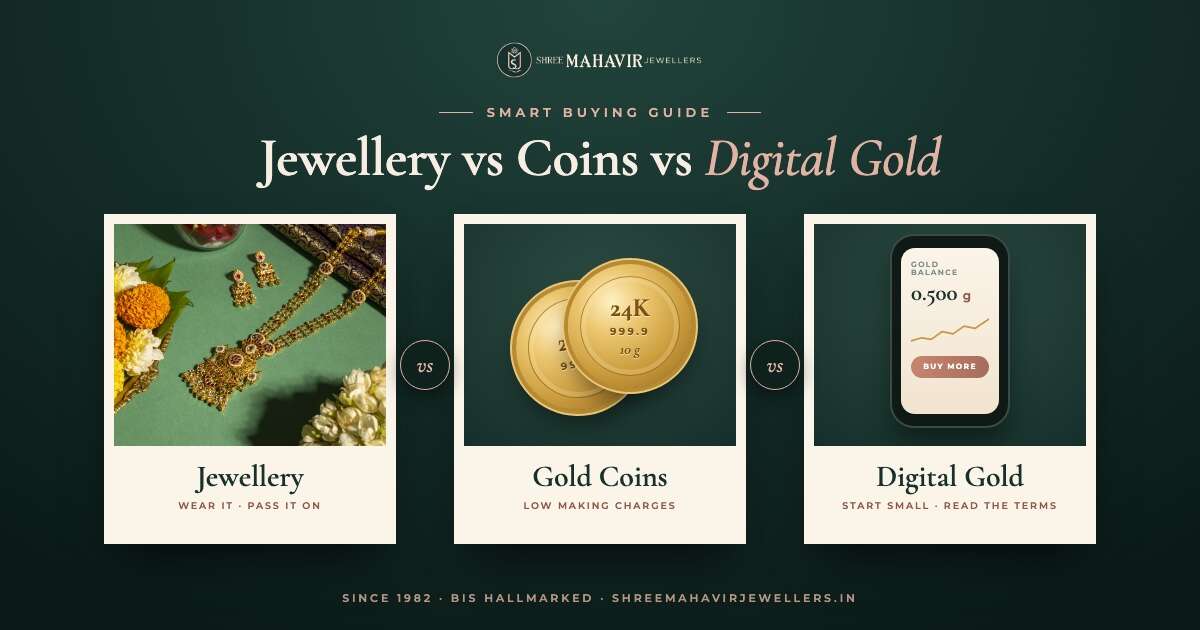
Every form of gold sits somewhere on a spectrum between being something you can wear and show, and being something that holds value as efficiently as possible. Jewellery sits at one end: it’s wearable, giftable, and carries sentimental and cultural weight that nothing else on this list offers, but it’s the least efficient way to simply hold gold value. Coins sit in the middle: not wearable, but physical, simple, and far closer to pure gold value. Digital gold sits at the other end: the most convenient to buy and the least tied to anything physical at all.
Jewellery: What You’re Really Paying For
When you buy jewellery, a meaningful part of the price has nothing to do with the gold itself. Making charges, the cost of design, craftsmanship, and labour, are added on top of the gold value, and depending on the design’s complexity, this can be a noticeable percentage of the total price. GST adds another layer: 3% on the gold value and a separate 5% on making charges.
Here’s the detail that matters most if you’re thinking about jewellery as an investment rather than purely as something to wear: making charges are generally not recoverable when you later sell or exchange the piece. You paid for the craftsmanship once, at the point of purchase, and that value doesn’t come back to you at resale, you’re paid based on the gold content and purity alone. This isn’t a flaw in jewellery as a category, it’s simply the nature of what you’re buying: beauty and wearability, not a pure store of value. If that’s genuinely what you want, jewellery remains the right choice, and nothing else on this list substitutes for a piece you can actually wear to a wedding or pass down to your daughter.
Gold Coins: The Middle Ground
Coins strip away almost everything jewellery adds. There’s no elaborate design to pay for, no stone-setting, no intricate finishing, which is why coins typically carry much lower making charges than jewellery, often in the range of a few percent rather than the far higher charges a detailed design can carry. That difference compounds in your favour both when you buy and, more importantly, when you eventually sell, since there’s simply less non-gold cost built into the price to lose.
Coins are also straightforward to value: a known weight, a stated purity (usually 24 karat for pure investment coins, sometimes 22 karat), and a BIS hallmark with its HUID code just like any other gold product. What coins don’t offer is wearability or the emotional weight of a chosen design, which is exactly why they work best for gifting on auspicious occasions or for buyers who simply want to hold gold without any intention of wearing it.
Digital Gold: Convenient, But Read the Fine Print
Digital gold lets you buy a small amount of gold instantly through an app, often starting from a very small sum, with the provider claiming to hold physical gold on your behalf in a vault. It’s genuinely the most convenient entry point into gold ownership, and it’s become popular for exactly that reason, particularly among younger or first-time buyers who want to start small without visiting a shop.
The important thing to understand, and the thing we think every customer asking about digital gold deserves to hear plainly, is that digital gold is not currently regulated by any Indian financial market regulator. The securities regulator issued an advisory flagging this directly, warning that digital gold platforms operate outside the regulatory frameworks that govern more established gold-backed instruments, which means there’s a layer of counterparty risk, essentially, trusting that the platform and its vaulting partner actually hold and will honour the gold they claim to, that doesn’t exist in the same way with a coin sitting in your own locker or jewellery you can physically hold. For comparison, other gold-backed financial instruments like Gold ETFs are regulated and have a different risk profile. This doesn’t mean digital gold is automatically unsafe or shouldn’t be used, but it does mean it’s worth treating as a convenience product rather than a long-term store of serious value, and definitely worth only buying through an established, reputable platform rather than an unfamiliar app offering an unusually attractive deal.
One more practical point: digital gold usually isn’t something you keep forever in digital form. Most platforms let you convert holdings into physical gold, coins or jewellery, after you’ve accumulated enough, but that conversion typically comes with its own delivery charges and making charges if you choose jewellery, so the efficiency advantage of digital gold narrows considerably the moment you actually want to hold something physical.
So Which One Is the Smarter Buy?
The honestly unsatisfying but accurate answer is that it depends on what job you need the gold to do.
If you want something to wear, to gift for a wedding, to pass down as a family piece, jewellery is simply the right category, and comparing it to coins on pure investment efficiency is comparing two different products. The making charges are the price of getting something wearable and meaningful, not a cost you’re being tricked into.
If your goal is closer to pure saving, holding gold value with minimal erosion from charges, coins are generally the more efficient physical option, and they remain a very sensible choice for festival gifting, Dhanteras and Akshaya Tritiya purchases, or simply building a small gold holding over time without the premium jewellery carries.
If convenience and starting small matter more than anything else, digital gold has a real place, but go in with your eyes open about the regulatory gap, and treat it as a stepping stone toward eventually holding something physical rather than a permanent home for serious value.
In practice, a lot of our customers end up doing more than one of these: jewellery for the pieces they’ll actually wear, a coin or two picked up around festivals as a simple gold holding, and sometimes a small digital gold habit for convenience. There’s no rule that says you have to pick just one.
Whatever You Choose, Insist on the Same Basics
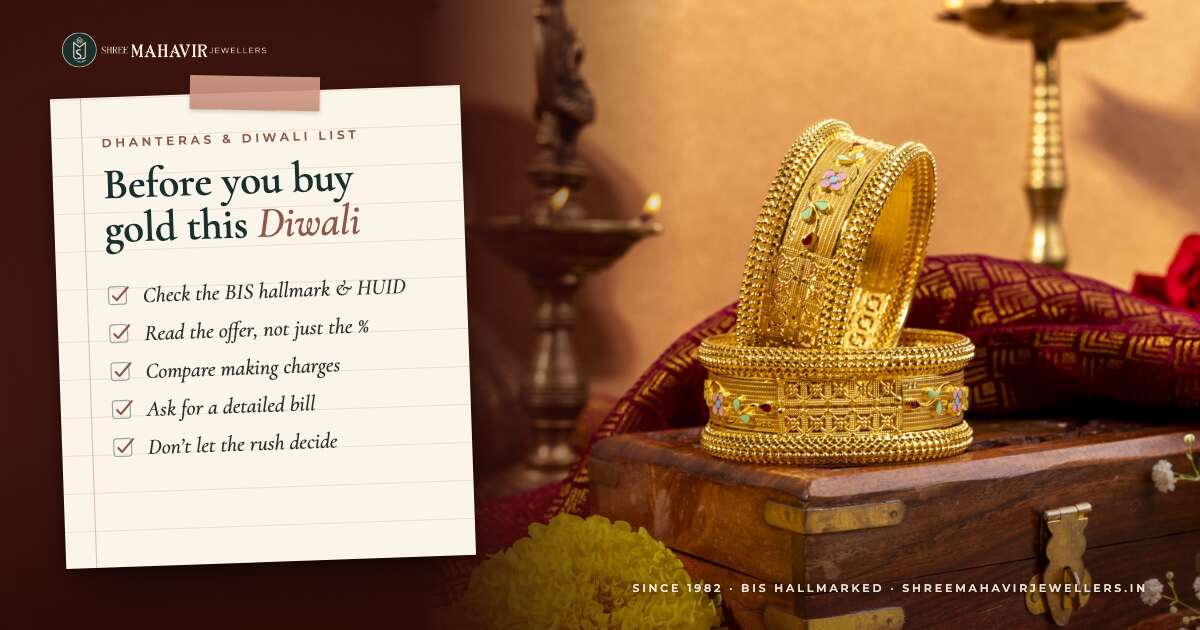
Regardless of which form you go with, the fundamentals don’t change. Any physical gold, coin or jewellery, should carry a valid BIS hallmark with its individual HUID code, verifiable on the BIS CARE app. Get an itemised bill showing gold value, purity, weight, and making charges separately. And be honest with yourself about what you actually need the gold to do before you decide which form to buy, since that one question settles almost everything else.
We stock a full range of BIS hallmarked jewellery at our Ghatkopar West showroom, from everyday pieces like rings and earrings to statement pieces like necklace sets, alongside gold coins for anyone who wants the simpler, more efficient option. Come in and talk it through with us, we’d rather help you buy the right form for your actual goal than sell you whatever’s easiest. We’re open Friday through Wednesday, 11am to 8:30pm, on L.B.S. Marg.