Almost every family in India has a drawer somewhere with a few pieces of gold nobody wears anymore. A pendant from a design that went out of fashion two decades ago, bangles that no longer fit, a chain with a broken clasp that’s been “waiting to get fixed” since before anyone can remember. The most common thing people do with that gold, eventually, is exchange it toward something new. It’s also one of the least understood transactions in the whole jewellery-buying process, because unlike buying new jewellery, where the price on the tag is the price, exchange involves testing, deductions, and a formula most customers have never had explained to them properly.
We handle old gold exchange every week at our counter in Ghatkopar West, and the questions we get are almost always the same ones. So this is the walkthrough we’d give you in person, written down.
What Actually Happens When You Bring In Old Gold
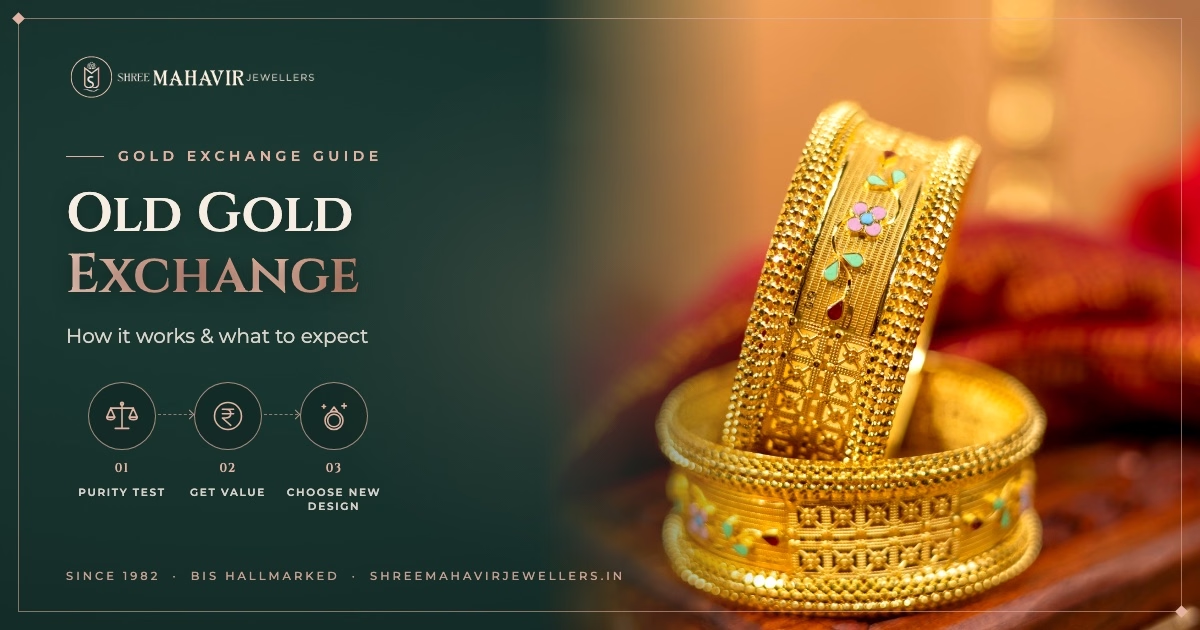
The process has a fixed sequence at any reputable jeweller, and it’s worth knowing each step so you understand what you’re watching happen to your piece.
Step one is purity testing. Before anything is priced, the jeweller needs to know exactly how much pure gold is in your piece. Most jewellers today use an XRF (X-ray fluorescence) machine, a non-destructive test that reads the composition of the metal without melting or damaging it. This is the same technology used to verify purity claims elsewhere in the trade, and it gives a reliable purity reading in a couple of minutes. If a piece is old enough or complicated enough (heavily set with stones, soldered joints of different purities, or visibly worn plating), a jeweller may also do a touchstone or acid test as a cross-check, or in some cases recommend a small assay cut.
Step two is weighing. The piece is weighed on a calibrated scale, generally in front of you. If it has stones, enamel work, or other non-gold material attached, a good jeweller will either weigh those separately and deduct their weight, or explain clearly how that deduction is being calculated, since you should only be paid for the actual gold content, not the total gross weight of the piece.
Step three is valuation. This is where purity and weight combine with the day’s gold rate to produce a value, and it’s also where most of the confusion happens, so it gets its own section below.
Why the Exchange Rate Isn’t the Same as “Today’s Gold Rate”
This is the single most important thing to understand, and the thing that catches first-time exchangers off guard most often. The rate you see quoted on the news or on a jeweller’s price board each morning is typically the selling rate for new gold. The rate applied when a jeweller buys back your old gold is a separate, lower figure, and that gap is completely normal and not a sign you’re being cheated.
There are a few honest reasons for the gap. Refining old gold back to usable purity involves a genuine process cost, melting it down, removing impurities, and re-casting or re-alloying it to the purity needed for new pieces, and that cost has to be accounted for somewhere. There’s also a small margin most jewellers build in on both the buying and selling side of any transaction, which is standard for any business dealing in a traded commodity. What varies quite a lot between jewellers is how transparent they are about exactly what that buyback rate is and how it was calculated, and that’s the thing worth asking about directly before you agree to anything: ask for the exact rate per gram being applied to your old gold, separately from the rate being applied to whatever you’re buying.
Understanding the Full Deduction Picture
Beyond the rate gap itself, there are a few specific deductions worth knowing to expect, so none of them come as a surprise at the counter:
- Purity-based value, not stated karat. If your old piece was bought decades ago and its stated purity can no longer be verified against a valid hallmark, the jeweller’s own test result is what determines its value today, not whatever was written on an old, possibly lost, receipt.
- Stone and setting deductions. Diamonds, coloured stones, enamel work, and any non-gold material are not gold, so their weight is deducted from the gross weight before the gold value is calculated. This is standard practice, not a way of shortchanging you, but it’s worth watching the scale and asking for the net gold weight explicitly.
- Wastage or refining deduction. Some jewellers apply a small additional deduction to account for loss during the refining process. If this applies, it should be disclosed to you as a clear percentage before the transaction, not buried into a vague final number.
None of these deductions are unusual on their own. What separates a good exchange experience from a frustrating one is simply whether each one is explained clearly, in order, with numbers you can see and add up yourself. If a jeweller won’t walk you through the arithmetic, that’s worth treating as a signal in itself.
Exchange Toward New Jewellery: How the Math and GST Actually Work
Most old gold exchange happens as part of buying something new, rather than as a standalone cash sale, and the value of your old gold is typically applied as a credit against the price of the new piece. On the new purchase itself, GST in India is charged at 3% on the value of the gold and 5% on making charges, a structure that applies whether or not you’re using exchange credit toward the purchase. It’s worth asking your jeweller directly how GST is being applied specifically to the exchange portion of your bill, since billing practices can vary, and getting a clear, itemised invoice protects you either way; you’ll want that documentation later regardless, for insurance, resale, or simply your own records.
What to Bring, and What Gets Asked For
A valid government-issued photo ID, such as Aadhaar, PAN, a passport, or a driving licence, is standard practice for any gold exchange transaction, largely as a routine KYC step most reputable jewellers follow. Separately, under income tax rules, quoting a PAN card becomes mandatory once a jewellery transaction crosses ₹2 lakh in value, and cash payments above that threshold in a single transaction aren’t permitted under income tax law regardless of payment method for the balance. None of this is specific to any one jeweller; it’s a standard regulatory requirement across the industry, and a shop that asks for ID and PAN at the appropriate thresholds is simply following the law properly, which is exactly the kind of jeweller you want to be dealing with.
If you still have the original purchase invoice, bring it. It’s not required for testing purity (the jeweller will always test the actual metal rather than rely on an old bill), but it’s useful supporting documentation and can occasionally be relevant depending on the piece and the transaction size.
A Note on Antique and Heirloom Pieces
Because we work in both contemporary and antique-style gold jewellery, we get this question often: what happens when the piece being exchanged is genuinely old, a grandmother’s bangle, a decades-old family pendant, something with sentimental weight far beyond its gold content? Practically, from a valuation standpoint, the piece is tested and valued the same way any other gold is: by its actual tested purity and net weight today. The sentimental value and the craftsmanship don’t factor into the melt value, because exchange value is fundamentally about the gold content, not the design or history. If a piece has genuine antique, artisanal, or design value beyond its gold content, that’s a completely separate conversation worth having before you decide to exchange it at all; sometimes the right answer is to keep a piece, have it professionally cleaned or repaired instead of melted down, or pass it along in the family rather than exchange it, and any jeweller who has your interests in mind should be willing to have that conversation honestly rather than simply pushing you toward a transaction.
When Exchange Isn’t Actually the Best Option
Exchange makes sense when you genuinely want new jewellery and have old gold sitting unused. It’s a poor fit if you actually just need cash rather than new jewellery, since selling gold outright and taking a gold loan against it are both separate paths with their own trade-offs worth comparing before you decide. A gold loan, in particular, lets you access funds while keeping ownership of the piece, which is worth knowing about if you’re not fully certain you want to part with it permanently.
What a Fair Exchange Looks Like in Practice
Put simply: your piece gets tested in front of you, weighed with any deductions explained clearly, valued at a stated rate per gram that you can compare against the day’s published gold rate, and the whole calculation is shown to you on paper before you agree to anything. That’s the standard we hold ourselves to at Shree Mahavir Jewellers, and it’s genuinely not a complicated bar to clear, it just requires a jeweller willing to be transparent about numbers rather than rushing you past them.
If you have old pieces sitting in a drawer and you’re thinking about exchanging them toward something new, whether that’s a fresh mangalsutra, a set of bangles, or a piece from our necklace-set collection, bring them by our Ghatkopar West showroom and we’ll walk you through the exact testing and valuation in person, no obligation to buy anything on the spot. We’re open Friday through Wednesday, 11am to 8:30pm, on L.B.S. Marg.