Ask a woman who has worn the same mangalsutra for fifteen years what she’d change about it, and she almost never says the design. She says the clasp, or the length, or how the chain sat against her collarbone during the first hot Mumbai summer she wore it every day. The design decision, the part everyone agonizes over in the showroom, tends to matter less over time than the practical choices buried underneath it: purity, chain construction, weight, and length. This guide is about both halves, because a beautiful mangalsutra you end up not wearing is not actually doing its job.
At Shree Mahavir Jewellers, we’ve sat across the counter from three generations of Ghatkopar families making this exact decision, so this is written the way we’d actually talk you through it in the store, not as a glossy trend roundup.
What a Mangalsutra Is Actually For
Before design, it helps to be clear on function, because the two are connected. A mangalsutra is tied or worn as a marker of marriage, and its most recognisable feature, the black beads, are traditionally believed to have a protective quality: warding off the evil eye and negative energy directed at the couple. That’s not a marketing line, it’s the actual cultural root of the design, and it’s why the black beads appear across almost every regional variation even when everything else about the piece changes.
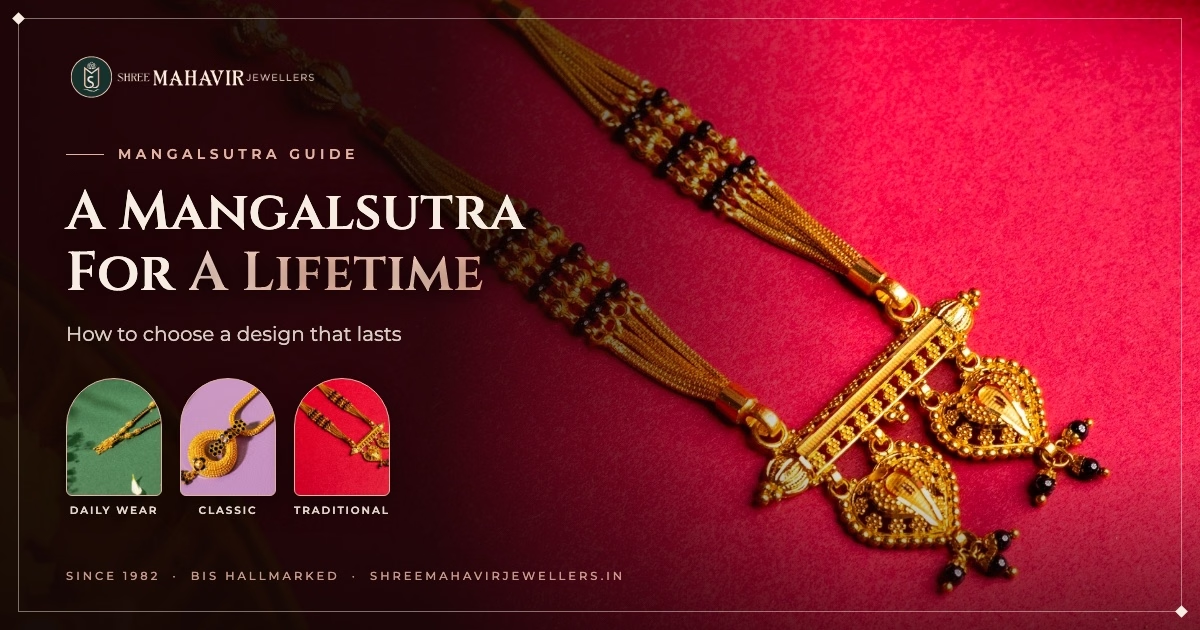
And it does change a lot by region. In Maharashtra, the classic design pairs two gold vatis, cup-shaped domes, on either side of the black beads, symbolizing husband and wife. South Indian mangalsutras often lean more heavily gold-forward with fewer black beads and more elaborate pendant work, sometimes incorporating temple-style motifs. In much of North India, the more familiar form is a chain with black beads spaced evenly along its length, often paired with a simpler central pendant. None of these is “more correct” than another; they reflect the region and community the design tradition comes from, and a lot of buyers today mix elements deliberately, choosing a design that nods to their own family tradition while fitting how they actually want to wear it.
Start With How You’ll Actually Wear It
The single most useful question to ask yourself before looking at a single design is not “which one is prettiest” but “will this be my everyday piece, or my occasion piece, or both.” That answer changes almost every other decision downstream.
If it’s going to be worn every single day, under a work blouse, through the school run, through cooking and cleaning and commuting, you want something genuinely light. Daily wear designs typically sit in a lighter gold weight range, built for comfort over eight, ten, twelve hours at a stretch, rather than the heavier, more elaborate pieces meant for a wedding day or a festival evening. A heavier design that looked stunning in the showroom mirror can become a piece you quietly stop wearing within a year if it’s not comfortable for daily life, and that defeats the entire purpose.
If you already own, or are planning to own, a more elaborate bridal mangalsutra for occasions, it’s worth thinking of your everyday piece as a completely separate purchase with completely separate priorities: comfort and durability first, ornamentation second. Many of our customers eventually own both, a substantial, more traditional piece for festivals and family events, and a lighter, shorter chain for daily wear, and that’s a genuinely sensible way to split the decision rather than compromising on one piece that has to do everything.
Chain Length: The Decision Most People Skip
Length matters more than most first-time buyers expect. A longer mangalsutra, often worn at a length that sits lower on the chest, has traditionally been common in more formal or festive contexts and pairs naturally with a saree. A shorter length, sitting closer to the collarbone, tends to work better under everyday western and Indo-western clothing, office wear, and kurtas, and simply catches on fewer things during a normal day. If you wear predominantly sarees, a longer traditional length might genuinely make more sense for you. If your day-to-day wardrobe is mostly salwar suits, western wear, or office clothing, a shorter length is usually the more comfortable everyday choice. Try this on physically before deciding; it’s one of those things that reads completely differently on a hanger versus on you.
Chain Construction: Rope, Vati, Box, and Cable
The construction of the chain itself affects both how it looks and how it holds up. Rope-twist and vati-style chains are popular specifically for daily wear because their construction resists tangling and lies flat and close to the neck, which matters a great deal over months of continuous wear. Box chains and cable-link constructions tend to sit slightly more prominently and are often chosen for heavier, more occasion-oriented pieces. If daily wear is the goal, ask specifically about the construction, not just the overall look; two designs that appear similar in a case can behave very differently against skin and clothing over a year of actual use.
18K or 22K: The Purity Question Specific to Mangalsutras
This comes up constantly, and it’s a genuinely useful distinction to understand rather than just defer to habit. 22 karat gold (916 purity) is the more traditional choice across most of India and has a richer, warmer colour that many buyers specifically want for a piece with this much sentimental and cultural weight. 18 karat gold (750 purity) contains a higher proportion of alloy, which makes it a noticeably harder, more scratch-resistant metal, an advantage for a chain that’s going to rub against clothing, brush against countertops, and generally take daily wear-and-tear for years without ever coming off.
Neither is objectively better; it’s a genuine trade-off between traditional colour and richness on one side, and daily durability on the other. Some buyers resolve this by choosing 22K for an occasion-only piece and 18K for the daily chain. Whichever purity you choose, the piece should carry a valid BIS hallmark with its individual HUID code, the same certification standard that applies to any gold jewellery purchase, mangalsutra or otherwise. If you haven’t read through what that hallmark actually means, it’s worth five minutes before any gold purchase, not just this one.
Black Beads: Material and Care
The black beads themselves are usually glass, though some designs use other materials, and they’re the part of the piece most likely to show wear over years of daily use: fading, chipping, or dulling from contact with skin, soap, and perfume. A few habits genuinely extend their life: wiping the piece dry after wearing it, especially after a shower or a humid day, avoiding contact with perfume and lotion directly on the beads where possible, and storing it separately from other jewellery so the beads don’t get scratched by harder metal edges in a crowded jewellery box. None of this is complicated, but it’s the kind of thing nobody mentions at the point of sale and everyone wishes they’d known a year in.
The Clasp Matters More Than It Looks Like It Should
This is the detail we push hardest on in-store and the one first-time buyers almost never ask about. A piece you’re putting on and taking off daily, or more likely simply never taking off, needs a clasp that’s genuinely secure and genuinely easy to manage on your own, since a mangalsutra is one of the few pieces of jewellery many women wear continuously rather than removing at night. A fiddly or worn clasp is how mangalsutras actually get lost, not through some dramatic mishap but through a small, tired mistake at the end of a long day. Ask to test the clasp yourself in the store before you decide, not just admire the design.
Pendant Style: Traditional, Minimal, or Diamond-Set
Pendant design is where personal taste has the most room to move. Traditional motifs (vatis, temple-inspired work, coin-style pendants) sit at one end; minimal, almost invisible small pendants sit at the other, popular specifically because they’re barely noticeable under office wear yet still fulfil the tradition; and diamond-set or stone-set pendants sit somewhere in between, adding a bit of shine without the bulk of a fully ornamental gold piece. There’s no wrong answer here as long as it’s honest about how you actually dress day to day, rather than how you dressed for the one function where you first saw a design you liked.
Bringing It Together
If we were sitting across the counter with you, the order we’d actually walk through is: how you’ll wear it day to day, then length, then chain construction, then purity, then pendant style, in roughly that order of practical importance. Design catches the eye first, but the pieces that get worn happily for twenty years are the ones where the boring decisions, clasp, construction, length, got made properly before the pretty ones.
We carry a full range of mangalsutra designs at our Ghatkopar West showroom, from traditional heavier festive pieces to lighter everyday chains, all BIS hallmarked with individually traceable HUID codes. If you’re weighing a matching set for a wedding, it’s also worth looking at our necklace sets alongside it, since many brides coordinate the two. Come in and actually try a few lengths and constructions against your own neck and your own wardrobe; it tells you more in five minutes than any amount of browsing online. We’re open Friday through Wednesday, 11am to 8:30pm, on L.B.S. Marg, and we’re genuinely happy to spend the time on this one, given what it represents.