“Is this 22K or 24K?” is one of the most common questions we hear across our counter, usually followed by “and which one should I buy?” It’s a fair question, and the honest answer is: it depends entirely on what you’re buying it for. Here’s what actually separates the two, beyond just the number.
What the Karat Number Actually Measures
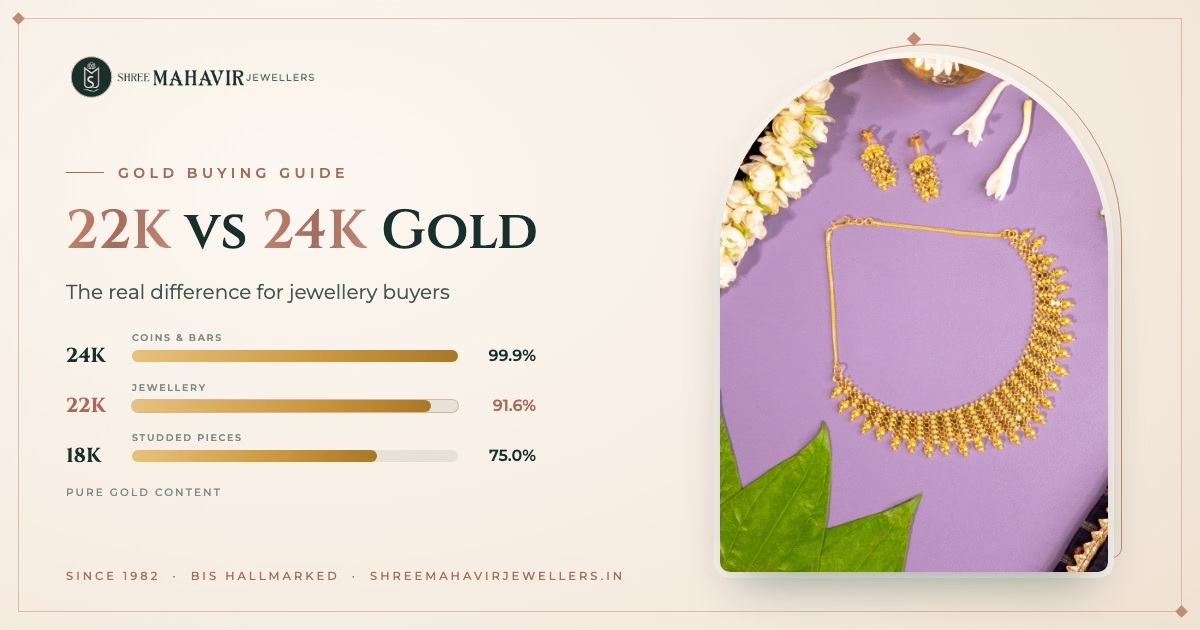
Karat measures gold purity out of a scale of 24. 24 karat gold is as close to 100% pure gold as jewellery-grade gold gets, no other metals mixed in. 22 karat gold means 22 parts out of 24 are pure gold, with the remaining 2 parts made up of other metals, typically small amounts of silver, copper, or zinc, alloyed in deliberately.
In percentage terms, 24K works out to roughly 99.9% pure gold, while 22K comes out to about 91.6%, which is exactly why you’ll see “916” stamped on 22K hallmarked jewellery. That number isn’t arbitrary; it’s the precise purity percentage, stamped directly onto the metal as part of the BIS hallmarking process.
Why 24K Gold Rarely Ends Up as Jewellery
Pure gold is a genuinely soft metal, soft enough that a ring made from 24K gold would bend, scratch, and lose its shape far more easily than most people would find acceptable for something worn daily or handled regularly. This is precisely why 24K gold is far more commonly used for coins, bars, and investment-grade gold rather than jewellery that needs to hold intricate detailing, set stones securely, or simply survive years of everyday wear.
When alloy metals are mixed in to bring gold down to 22K, they don’t just dilute the purity, they genuinely change the metal’s physical properties. The alloy adds structural strength, making the gold more resistant to scratching, denting, and bending, while still retaining gold’s rich, warm colour and most of its inherent value.
Why 22K Became the Standard for Indian Jewellery
This is why 22K gold has been the standard purity for traditional Indian jewellery for generations, bangles, mangalsutras, temple sets, and heavy bridal pieces all rely on that extra durability to hold their shape and intricate detailing through years of wear, festivals, and being passed down across generations. The colour also matters here: 22K gold retains a distinctly rich, warm yellow tone that’s closely associated with traditional Indian jewellery aesthetics, whereas gold alloyed down further (as in 18K or 14K) can shift toward a paler or more muted tone depending on the specific alloy mix used.
So Which Should You Actually Choose?
This comes down to what the piece is for, not which purity is objectively “better”:
- Choose 22K when you want traditional richness of colour, resale value close to the day’s gold rate, and durability for pieces meant to be worn regularly or passed down, bangles, mangalsutras, and most traditional Indian designs fall firmly into this category.
- Consider 24K primarily for investment purposes, coins, bars, or pieces you don’t intend to wear regularly, since its softness makes it impractical for anything that needs to survive daily handling.
- 18K or lower tends to suit heavily gem-set or diamond-studded pieces, where additional hardness helps hold stones securely, often at the cost of some of that classic warm gold tone.
There’s a common misconception that 24K is simply “better” because it’s purer, but purity and suitability for jewellery aren’t the same thing. The right purity is the one that matches how you’ll actually wear and use the piece.
How to Confirm What You’re Actually Buying
Regardless of which purity you choose, the purity number should always be stamped directly on the piece as part of a complete BIS hallmark, alongside the BIS triangle logo and the unique HUID code. If you’d like a refresher on reading a hallmark properly, we’ve covered that in detail in our bridal jewellery buying guide and our dedicated hallmark verification guide, it takes less than a minute to check once you know what you’re looking for.
At Shree Mahavir Jewellers, our bangles, necklace sets, and traditional collections are predominantly crafted in 22K gold, in keeping with the durability and richness that traditional Indian jewellery has always called for, while select pieces across our pendant sets and rings use 18K where gemstone settings benefit from the added strength. If you’re ever unsure which purity suits a piece you have in mind, our team is happy to walk you through the trade-offs before you decide, purity is one choice you shouldn’t have to guess at.